


Upper designed for easy run-up like a short distance
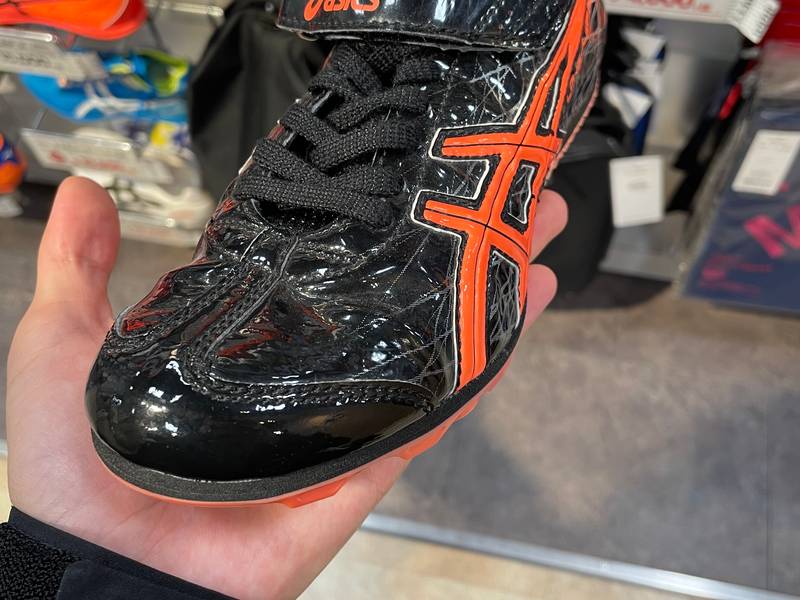
The upper features both laces and a strap, which are common for long jump spikes. It fits securely to the foot with laces and holds the foot firmly with the strap. The enamel-like material used in the upper is made of synthetic leather, so there are individual differences in usage frequency, but after about three months of wearing, it becomes softer and conforms to the foot.
As it becomes accustomed, the resistance felt during the approach decreases, making it easier to run.
Since it is covered entirely in enamel-like synthetic leather, you cannot expect much breathability. However, while it lacks breathability, it conversely prevents sand from entering to a certain extent.
Foot width designed to be just right for Japanese people
In terms of width, when compared to other long jump spikes, it is narrower than Mizuno and wider than Nike.
It does not have a particularly unusual shape, and as mentioned at the beginning, it has a shape that is comparable to sprint spikes.
The heel part has cushioning and is designed not to restrict ankle movement. However, it is unclear whether this cushioning has a positive impact on performance.
As a personal opinion, I feel that this cushioning makes the spikes a bit easier to put on and take off.

Sole designed for easy run-up like a short distance
The sole is relatively curved, and sharkskin is incorporated in the heel area.
It features a two-layer structure of nylon (outer layer) and urethane (mid-layer). If Nike's Zoom LJ4 is a sole that pursues hardness, the Long Jump PRO can be said to focus on rebound and the ability to return to its original shape.
The number of pins is relatively high at nine, the same as Mizuno's Field Geo LJ, with four pins positioned along the ball line of the toes that firmly grip the tartan, reducing lateral sway at takeoff and supporting a straight launch.
Additionally, compared to the 2-3-4 configuration of the Field Geo LJ-B, the Long Jump PRO has a 1-3-5 configuration, allowing for better pin release and making it easier to jump without losing speed.


Pin configuration that balances takeoff and run-up
Regarding the curvature, five pins are arranged in an arc directly under the ball of the foot, curving to form a peak. When standing upright, these five pins contact the ground, and as you start your approach, four pins located at the front half of the foot engage and function. This structure helps stabilize the five pins during standing and takeoff, while minimizing interference during the approach, making it less likely to experience deceleration due to friction. This further enhances the ease of approach, following the upper.
However, while I have described it as similar to sprint spikes, the curvature of the sole is indeed flatter compared to that of sprint spikes.


